
Japan Travel · Luggage
Advertisement: This article contains affiliate links. We may earn a commission if you book through them. Prices and locker counts change — always check the price on the locker screen before you pay.
You step off the Shinkansen at Tokyo, Kyoto or Shin-Osaka with a suitcase that weighs more than your plans for the afternoon. A coin locker is the obvious answer — and for a few hours, it is a very good one. But Japan’s station lockers are built for short stops, not for storing a bag for a week, and the largest lockers are the scarcest.
This guide uses only official sources — JR East, Tokyo Station City, JR East Smart Logistics, ASTY Kyoto and the Osaka tourism board — for sizes, prices and time limits. Where an official page does not publish a number, it says so. Prices are in yen, checked on 24 November 2026.
Sizes, prices and what fits
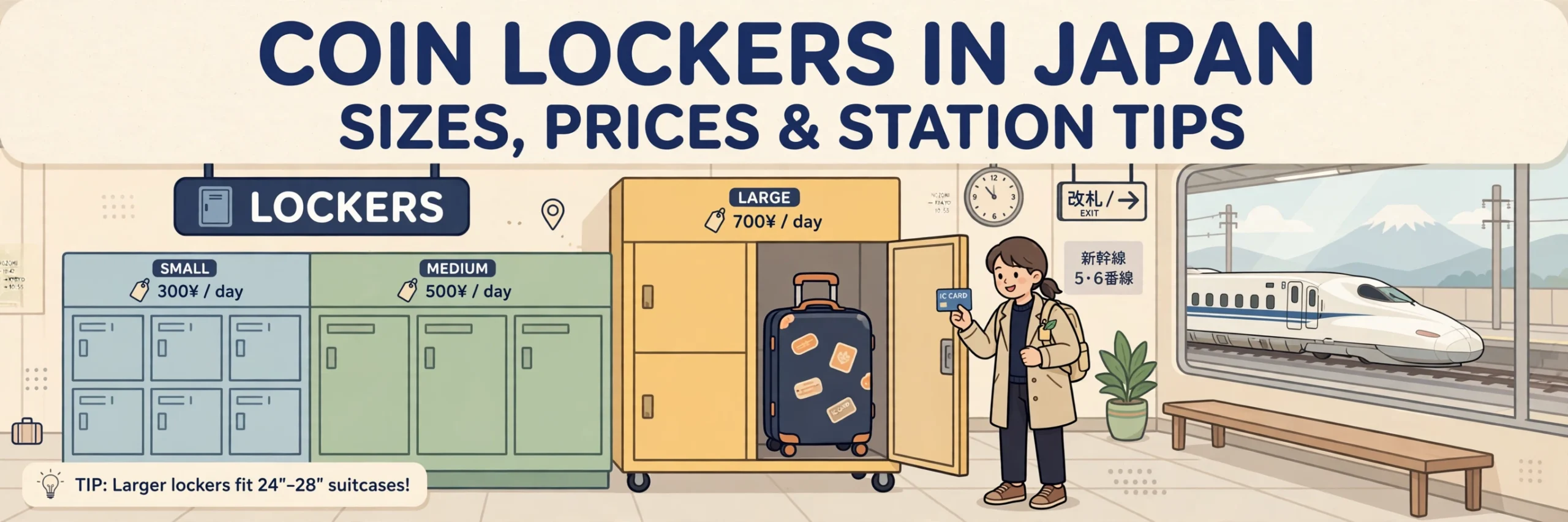
Locker sizes are not standardised across Japan, and the same letter can mean a slightly different box at another station. The table combines the two official charts we could verify: ASTY Kyoto’s exact centimetre dimensions, and JR East’s price ranges for Tokyo Station.
| Locker | Size (W × D × H) | Price | What fits |
|---|---|---|---|
| Small | 35.5 × 57.5 × 31.6 cm (ASTY Kyoto) | ¥400 in Kyoto; SS ¥300 / S ¥500 in Tokyo | A daypack, a tote or shopping bags. A cabin roller will not stand up in it. |
| Medium | 35.5 × 57.5 × 40.4–55.0 cm (ASTY Kyoto) | ¥500 in Kyoto; ¥700–¥800 in Tokyo | A standard cabin roller (about 55 × 40 × 20 cm) laid on its side, or a backpack plus a daypack. |
| Large | 35.5 × 57.5 × 66.8 cm (Large A) or 84.3 cm (Large B) | ¥700 in Kyoto; ¥900–¥1,000 in Tokyo | A medium checked suitcase (about 65 cm tall) in Large A; a large checked suitcase (about 75 cm tall) in Large B. |
| Extra-large (keyless, Kyoto) | 53.3 × 64.5 × 113.5 cm | ¥1,000 in Kyoto | The largest suitcases, or two medium bags. Watch the 30 kg weight limit below. |
How to read the sizes: first number width, second depth, third height. A suitcase usually fits turned on its side, so compare all three of your bag’s measurements — including wheels and handle — with the locker’s three numbers. Nothing over 30 kg may go into a Multi-ecube locker, and the terms ban cash, valuables such as passports and laptops, animals and perishables.
Prices vary by locker bank and operator. Kyoto’s ASTY prices and Tokyo’s JR East ranges are the published figures; Shin-Osaka’s ordinary coin lockers have no single published flat price list, and one cashless bank there charges by the hour (see below). The price on the locker screen always applies.
The 3-day rule — the rule most travellers get wrong
Coin lockers are temporary storage, not left luggage for a whole trip. Under the Multi-ecube terms published by JR East Smart Logistics, a general deposit may stay for 3 days, including the day you put the bag in. Days are not 24-hour periods: a new day is added at 2:00am each morning, and the deposit day and collection day each count as a full day.
So a bag left on Monday is on day 1 Monday, day 2 Tuesday and day 3 Wednesday — collect it by Wednesday night. A fourth day is not an option you can buy, and each day past the first is charged again at the fee on the touch panel.
If you do not collect in time, the operator may open the locker, check the contents and move them to a designated place, kept separately for 30 days from the day you first used the locker. After that the bag is treated as abandoned and may be disposed of, with the cost charged to you. Food is disposed of immediately. Keep your IC card and receipt — you will need them, with identification, to get a bag back.
Tokyo Station
More than 100 locker locations, but few large ones
Tokyo Station has coin lockers in more than 100 places, inside and outside the ticket gates, according to JR East. Most banks are small and medium lockers; the large ones are a small minority.
- Yaesu North Gate (outside the gates, near the Shinkansen gates) — SS 5, S 80, M 51. No large lockers at all.
- Marunouchi Central Gate (inside the gates) — S 40, M 19. JR East calls this the easiest locker bank inside the gates to find — and warns that it may already be full.
- Marunouchi Underground Central / North Gates (inside, basement 1) — S 91, M 37.
- Marunouchi North Gate (outside the gates, North Free Passage) — S 39, M 26.
- GRANSTA basement 1 (inside the gates) — S 728, M 152, L 40. The largest locker bank inside the gates, with more than 900 lockers — and only 40 of them are large.
- Keiyo Underground Passage (on the way to the Keiyo Line) — SS 5, S 78, M 33.
All these banks are open from the first train to the last train. If you need a large locker, head for the GRANSTA basement bank first. Multi-ecube lockers can be reserved from a smartphone — place, date and size — from one month in advance, and Tokyo Station City’s locker map shows Suica locker availability in real time. In busy periods Multi-ecube adds ¥100–¥200 for medium and large lockers.
Staffed counters: the Shinkansen Parcel Service & Baggage Storage outside the Yaesu South Gate (5:30–23:00), the JR EAST Travel Service Center baggage storage by the Marunouchi North Gate, a cloak service in GRANSTA Tokyo (basement 1), and Baggage Storage+ by the GRANSTA Underground North Gate.
Kyoto Station
About 1,505 lockers at the Shinkansen Hachijo Exit
Kyoto Station’s main locker bank is run by ASTY Kyoto, on the Shinkansen Hachijo Exit side. It has about 1,505 coin lockers, open 24 hours, all year round, in 13 sections each marked with a different flower sticker — photograph your section and locker number, because every bank looks the same after a day of sightseeing.
Prices and sizes here are the clearest official chart of the three stations: small ¥400 (35.5 × 57.5 × 31.6 cm), medium ¥500 (up to 55.0 cm high), large ¥700 (66.8 or 84.3 cm high) and keyless extra-large ¥1,000 (53.3 × 64.5 × 113.5 cm). Keyless lockers take a transport IC card such as TOICA, Suica or ICOCA. A Locker Concierge service shows availability — check it before walking to the Hachijo (south/Shinkansen) side, a walk from the Karasuma (city) side.
If the large lockers are full, forward the bag to your Kyoto hotel instead of hunting through the station — our Tokyo to Kyoto luggage forwarding guide covers costs and timing.
Shin-Osaka Station
Many small banks, plus a cashless bank that charges by the hour
Shin-Osaka’s lockers are spread across nine banks, listed by the Osaka tourism board. The Main Entrance bank is the biggest (31 small, 68 medium, 51 large); the East Exit (South Side) bank is the only one listed with extra-large lockers — just four. The Alde Shin-Osaka bank (9/18/40) and the Central Exit ticket-gate bank (12/12/6) also have large lockers. Counts were published as of 1 October 2025.
One bank charges by time, not by the day: the JR West cashless lockers on the first floor, in front of the airport bus stop by the South Exit, are open 5:00–23:59. The first 60 minutes are free, then ¥300 every 3 hours for a small locker (¥900 per 24 hours), ¥400 for a medium (¥1,200) and ¥600 for a large (¥1,800). Reserve through the SPACER app, with a one-day ticket, from 24 hours in advance. Cashless payment only.
For a bag that is too big, or needed longer than a locker allows, there are two staffed counters. Crosta Shin-Osaka (9:00–20:00) stores a bag for ¥1,000 and delivers it to an Osaka hotel the same day for ¥2,000 a piece — nothing over 2 metres or 30 kg. The Nippon Travel Agency TiS Shin-Osaka counter (11:00–19:00) stores a bag for ¥1,000 a piece, credit cards only. Both need advance reservations.
When lockers are full or your bag is too big
A full bank of large lockers is not the end of the plan. In this order, these are the options that work.
1. Forward the bag to your next hotel
This turns a locker problem into a hands-free day. Luggage forwarding sends a suitcase from one hotel to the next, usually arriving the next day, so you travel with only a daypack. Our Tokyo to Kyoto guide covers costs and timing, and the Tokyo to Osaka guide covers that route. Heading to or from the airport, airport luggage delivery works the same way. Before you send anything, check the Shinkansen luggage rules: oversized bags need a seat with oversized baggage space.
2. Ask your hotel to hold the bag
Most hotels in Japan will hold your bags on check-in and check-out day, even before or after your room is ready — but the policy is the hotel’s own, not a right, and some hotels limit hours or bag numbers. Ask when you book. Our comparison of three Shinjuku hotels’ storage policies shows how much the rules vary, even in one city.
3. Plan the bags, not just the day
The cheapest fix is decided before you leave home: one cabin-size bag per person for the train days, and one large suitcase forwarded between hotels. The Japan Luggage Planner walks through that decision — which bag to forward, which to carry, when to send it. At the station, try the staffed counters above before walking between locker banks.
Do not leave a bag past the 3-day limit hoping nobody notices — the operator can open the locker and move the bag, and after 30 days it can be disposed of. And do not force a bag into a locker that is too small; a jammed door will cost more time than forwarding would have.
How to use an IC (keyless) locker
Keyless lockers work the same way at all three stations, with small differences on the screen. These steps are for a Multi-ecube or ASTY keyless locker.
- Find an empty locker — the screen or a green light shows which ones are free — and put your bag in. Close the door firmly.
- On the touch panel, choose your language and confirm the size and the fee shown.
- Pay with your transport IC card (Suica, ICOCA, TOICA and the other major IC cards), a QR-code payment or a credit card. Multi-ecube lockers do not take cash; older coin lockers take ¥100 coins, so carry both.
- Take the receipt the locker prints, and photograph the locker number and your section (in Kyoto, the flower sticker). You will need the same IC card — or the receipt — to open the locker again.
- If you come back after 2:00am on a later day, the panel will charge the extra day’s fee before it opens. Pay it with the same card.
- Collect the bag yourself: the terms say only the person who deposited the bag can take it out, so do not send a travel companion with a different card to collect it.
Frequently asked questions
The biggest published locker here is Kyoto’s keyless extra-large, 53.3 × 64.5 × 113.5 cm for ¥1,000 — a large checked suitcase of about 75–80 cm fits. At Tokyo, the largest published size is L (¥900–¥1,000), and only 40 of the 900+ lockers at the GRANSTA basement bank are large. Anything over 30 kg cannot go into a Multi-ecube locker; a bag longer than about 110 cm in any direction will not fit a standard locker — forward it instead.
Three days, including the day you put it in, under the Multi-ecube terms covering JR East’s lockers. A new day starts at 2:00am and every extra day is charged again. A bag left on Monday must be collected by Wednesday night. After the limit the operator may move the bag to separate storage for 30 days; after that it can be disposed of.
Check another bank — at Tokyo, the GRANSTA basement bank has the most large lockers (40); at Shin-Osaka, the Main Entrance and Alde banks have the most. Better, reserve ahead: Multi-ecube at Tokyo from one month in advance, Kyoto’s Locker Concierge shows availability, and Shin-Osaka’s SPACER lockers can be reserved from 24 hours ahead. Otherwise, forward the bag or use a staffed counter.
Both. Older coin lockers take coins (¥100 coins are the useful ones). Keyless lockers take transport IC cards such as Suica, ICOCA and TOICA, and Multi-ecube lockers also take QR-code payments and credit cards. Keep the IC card you paid with — you need the same card to open the locker — and keep the receipt.
The operator may unlock the locker, check the contents and move them to a designated place, kept separately for 30 days from the day you first used the locker. After 30 days the bag is treated as abandoned and may be disposed of, and the operator may charge you the cost. Food is disposed of immediately. To get a bag back you will need the IC card or receipt and identification, plus the extra fees.
Before you walk away — a 60-second checklist
- Measure your bag (height, width, depth, including wheels and handle) and match it to the table above.
- Choose the right bank before you arrive: GRANSTA basement 1 for large lockers in Tokyo, the Hachijo Exit in Kyoto, the Main Entrance in Shin-Osaka.
- Have both ¥100 coins and a charged IC card.
- Photograph the locker number, the bank and (in Kyoto) the flower sticker.
- Keep the receipt — and remember the 3-day limit and the 2:00am day change.
- If you need the bag for longer than 3 days, forward it or use a staffed counter instead.
Lockers are for the day, not the trip
Coin lockers at Tokyo, Kyoto and Shin-Osaka stations are at their best for what they were built for: a few hours of hands-free sightseeing between trains, or a night or two while you move between hotels. Choose the size from the centimetre table, respect the 3-day limit, and have a forwarding plan ready for the bag that does not fit.
Read next: Tokyo to Kyoto Luggage Forwarding: Costs & Timing · Tokyo to Osaka Luggage Forwarding · Airport to Hotel Luggage Delivery in Japan: Haneda & Narita Cutoff Times, Costs & How It Works · Shinkansen Luggage Rules · Shinjuku Hotels That Store Luggage After Checkout: 3 Policies Compared · Japan Luggage Planner
How we checked this guide
Sizes, prices, locker counts and time limits in this guide come from the official pages listed in Sources below, checked on 24 November 2026. Where an official page did not publish a figure — for example, a single flat price list for Shin-Osaka’s ordinary coin lockers, or the exact centimetre size of Tokyo’s SS, S, M and L lockers — this guide says so and does not invent one. Advice about a time of day by which large lockers fill was not used, because no official source we checked publishes one; the scarcity figures that are used (for example, 40 large lockers out of more than 900 at Tokyo’s GRANSTA bank) come from JR East’s own article.
Sources
- JR East (JRE Media), “Recommended coin lockers inside and outside the gates at Tokyo Station” (updated 20 October 2025) — 100+ locations, SS/S/M/L prices, locker counts by bank, Multi-ecube reservation from one month ahead. media.jreast.co.jp/articles/680
- Tokyo Station City, “Tokyo Station Map / Area Map — Coin Locker” — locker map, real-time Suica locker availability, To Locca reservations, staffed storage counters. tokyostationcity.com/en/information/#locker
- JR East Smart Logistics, “Multi-ecube Locker Terms of Use” — 3-day limit, 2:00am day count, per-day fees, IC / QR / credit payment, 30 kg limit, banned items, 30-day separate storage and disposal. jre-sl.co.jp/locker-terms2024/
- ASTY Kyoto, “Coin Lockers” — about 1,505 lockers at the Shinkansen Hachijo Exit, 24 hours, size and price chart in cm, keyless IC payment. asty-kyoto.co.jp/en/asty_kyoto/store/181/
- Osaka Tourism Bureau (Osaka Info), “A Complete Guide to Luggage Storage and Coin Lockers at Shin-Osaka Station” (information as of 1 October 2025) — locker counts by bank, Crosta and TiS counters. osaka-info.jp/en/handsfreetravel-osaka/sightseeing-from-shin-osaka-station/
- SPACER, “JR West — Shin-Osaka Station 1F, in front of the airport bus stop” — cashless locker hours, door counts and time-based fees. spacer.co.jp/en/base/op-161/






Comments